

Comparing detached vs semi-detached vs townhouse homes in Ontario usually starts with price, but the asking price only tells part of the story. What you are really paying for is land, walls you do not share, and the freedom to change the property later. This guide breaks down what each home type gives you and what it costs to own, so you can compare them fairly.
TL;DR
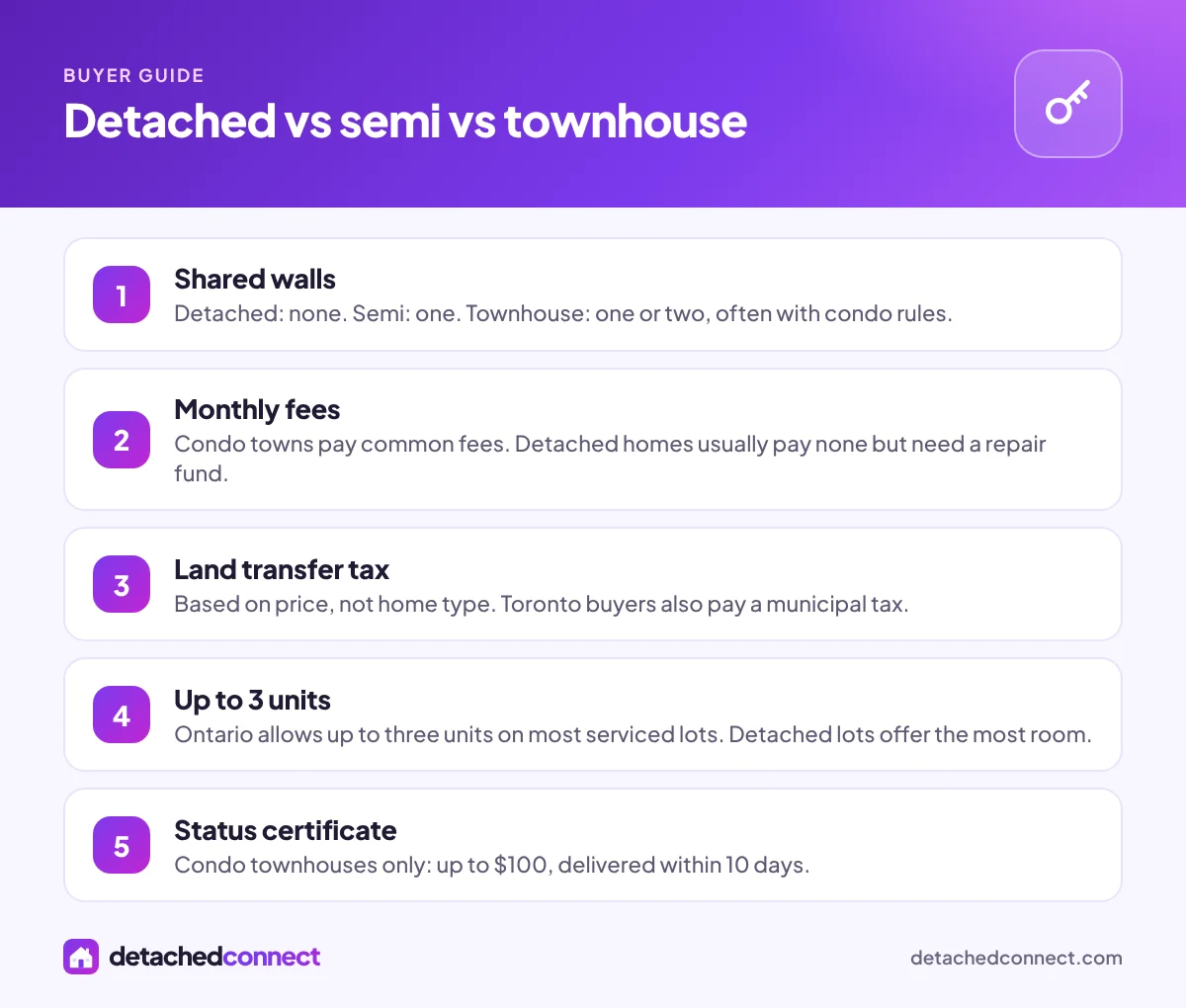
- A detached house sits on its own lot with no shared walls, a semi shares one wall, and a townhouse shares one or two and often comes with monthly fees.
- Land transfer tax is based on the price you pay, not the home type, so the real differences show up in ongoing costs.
- Condo townhouses carry monthly common expense fees and a status certificate review. Detached homes and most semis do not.
- Ontario now allows up to three units on most serviced residential lots, and a detached lot usually gives you the most room to use that rule.
What each home type actually is
Listings use these terms loosely, and ownership type matters as much as the building itself.
Detached house
A detached house stands alone on its own lot, with open space on every side, even if a side yard is only a metre or so wide. You usually own the land and the building outright (freehold), and every repair, from the roof to the sewer pipe running out to the street, is yours to plan and pay for.
Semi-detached house
A semi shares one wall, called a party wall, with the house next door. Each owner owns their own half of the lot, normally freehold with no monthly fee. You get yard space on three sides, but you are physically connected to a neighbour whose renovations, roof timing and upkeep can affect your half.
Freehold townhouse vs condo townhouse
A townhouse, or row house, shares a wall on one side (an end unit) or both sides (an interior unit). This is where buyers get caught out. A freehold townhouse means you own your lot, much like a semi. A condo townhouse means you own a unit inside a condominium corporation, pay monthly common expense fees and live by the corporation’s rules and budget. Some newer freehold towns sit on a parcel of tied land (often shortened to POTL) and still pay a monthly fee for shared roads, snow clearing or landscaping. Read how the listing describes ownership and have your lawyer confirm it before your offer goes firm.
What you get: space, land and privacy
The table sums up the practical differences. These are general patterns, so check each property.
| Feature | Detached | Semi-detached | Townhouse |
|---|---|---|---|
| Shared walls | None | One | One or two |
| Land you own | Full lot, open on all sides | Your half of a paired lot | Narrow lot (freehold) or a unit only (condo) |
| Monthly fees | Usually none | Usually none | Common for condo towns, sometimes for POTL freehold towns |
| Exterior decisions | Yours alone | Yours, but the party wall and roofline are shared | Often set by a condo board |
| Room for a suite or addition | Most options | Some options | Limited, and often barred in condo towns |
| Noise from neighbours | Least | Through one wall | Through one or two walls |
Land is the part you cannot add later
You can renovate a kitchen or finish a basement, but you cannot make a lot wider. A detached home gives you the whole lot, including side yards that can allow a separate entrance, a wider driveway or a path to the backyard that does not run through the house. Frontage and depth decide a lot of this, and our guide to lot size and frontage explains how to read the numbers on a listing.
Privacy and noise
Shared walls carry sound, especially in older homes built without modern sound insulation. In a semi or townhouse you may hear footsteps on the stairs, music or a barking dog. A detached home removes the shared wall, though a narrow side yard can still put your windows close to the house next door. If privacy is high on your list, look at window placement and side-yard width, not just the word detached.
What it really costs to own each one
Price gaps between the three types vary widely by city, neighbourhood and even street, so compare actual sold prices nearby rather than broad averages. What you can compare reliably is how the costs are structured.
Buying costs follow the price
Ontario land transfer tax is calculated on the purchase price, not the type of home, and buyers in Toronto pay a municipal land transfer tax on top. A semi and a detached house bought for the same price attract the same tax. You can run your own numbers with our mortgage and land transfer tax calculators. For a condo townhouse, budget for a status certificate review by your lawyer. The Condo Authority of Ontario explains that a corporation can charge up to $100 for the certificate, including taxes, and must provide it within 10 days.
Monthly fees
Condo townhouse fees pay for the corporation’s shared costs and its reserve fund for future repairs such as roofs, roads and windows. Fees can rise, and a thin reserve fund can lead to special assessments. A detached house has no fee, but that is not the same as no cost: you are your own reserve fund.
Maintenance and repairs
In a detached home you pay for everything inside and out: roof, eavestroughs, driveway, foundation, grading, windows and the sewer line to the street. The upside is control. You choose when and how the work gets done, and nobody can vote to raise your fee. A sensible habit is to set money aside every month for big items so a roof or furnace replacement does not become a crisis. Semi owners face the same list, but share decisions about the party wall and sometimes the roofline with the neighbour.
Tip: Ask the seller for receipts or dates for the roof, furnace, windows and any foundation or waterproofing work. On a detached home these are the items most likely to produce large bills in your first few years.
See detached homes as they list
Get new detached listings in the cities you care about by email, so you can compare real homes instead of averages.
Flexibility: suites, additions and extra units
Ontario’s planning rules now let owners add additional residential units as of right on most urban lots served by municipal water and sewer: up to three units in the main house, or two in the house plus one in a separate building such as a garage or garden suite. The province’s citizen’s guide to zoning bylaws covers the basics. The rule applies to detached, semi-detached and row houses, but the space and access to make it work are usually easiest on a detached lot. Toronto goes further and permits multiplexes of up to four units across the city.
In practice, a detached house with a side door, good basement height and a reasonably wide lot gives you choices: a rental unit, space for parents, or an office with its own entrance. Condo townhouses rarely allow this, and many condo declarations forbid it outright. Setbacks, parking, fire separation and building permits still apply, so confirm with your city and your lawyer before you count on rental income.
Resale: what buyers pay for
When you sell, you compete with similar homes nearby. Detached homes appeal to buyers who want space, privacy and fewer shared decisions, and in neighbourhoods where detached houses are scarce that can widen your pool of buyers. Semis are often a strong middle ground at a lower entry price. Condo townhouses are judged partly on the corporation: fee levels, reserve fund health and rules all show up in what buyers will offer.
The honest way to judge resale is to look at what similar homes actually sold for, not what they were listed at. You can request sold prices for any street you are watching.
How to decide: a five-step test
- List what you cannot change later: location, lot and shared walls. Rank how much each one matters to you.
- Price out the full monthly picture: mortgage, property tax, utilities, insurance, any fees and a maintenance reserve.
- Think five to ten years ahead: children, parents moving in, working from home or a rental unit.
- Compare recent sold prices for each home type on the same or nearby streets.
- Walk each property with a list like our detached home checklist so you compare like with like.
If your answers point to space, control and future options, a detached home is usually worth stretching for. If they point to lower upkeep and a lower entry price, a semi or freehold townhouse may be the smarter step for now. Browse detached homes by city to see what your budget buys today.
Key takeaways
- Confirm the ownership type (freehold, condo or POTL) before you compare prices.
- Land transfer tax depends on price, not home type. Ongoing costs are where the types really differ.
- A detached house has no monthly fee, but you need your own repair fund.
- The up-to-three-units rule covers all three types, but detached lots usually make it easiest.
- Judge resale with sold prices on the same street, not averages.
Frequently asked questions
Is a semi-detached house cheaper to own than a detached house?
The purchase price is often lower, and both are usually freehold with no monthly fee. Day-to-day costs are similar, but a semi owner shares decisions about the party wall and roofline with the neighbour.
Do freehold townhouses have monthly fees?
Many do not, but some newer freehold towns sit on a parcel of tied land and pay a monthly fee for shared roads or services. Your lawyer should confirm this before your offer goes firm.
Can I add a basement apartment to a semi or townhouse in Ontario?
Ontario allows additional residential units on most serviced lots with detached, semi-detached and row houses, but condo townhouses usually cannot. Permits, fire separation and local zoning still apply, so check with your city.
Is land transfer tax higher on a detached house?
No. Ontario land transfer tax and Toronto’s municipal land transfer tax are based on the price paid, so two homes at the same price pay the same tax regardless of type.
What should I compare first between home types?
Start with ownership type and any monthly fees, then lot size and frontage, then recent sold prices for each type on nearby streets.
Start your detached home search
Search detached listings across Ontario by city, style and price, then compare them against the five-step test above.